Photorealistic People on Gemini Omni 1.1 Flash: Delete the Word 'Beautiful'
The fastest way to make a generated human look fake is to ask for an attractive one.
Write beautiful woman, perfect skin, flawless, stunning and the model obeys — it reaches for the region of its training data where those captions live, which is retouched commercial photography. Pores gone, asymmetry gone, and the small tensions that make a face read as occupied by someone gone with them. Nothing in the output is wrong. The prompt asked for a beauty ad and got one.
Google's own prompt guidance points the other way in one sentence — "Be extremely detailed in your descriptions of characters and environments." Detailed, not complimentary. Those are different instructions and they produce different faces. What follows is the difference: faces, hands, the audio you cannot switch off, and where Google has decided you may not go.

A face is a list of facts, not a list of compliments
Every adjective is a vote for a caption cluster, and gorgeous votes for stock. 8k, hyperrealistic, masterpiece came from image-model folklore, where they served as quality tokens; on a video model with no sampling parameters they only compete with the words describing your shot. The replacements are specific and boring, which is the point:
Age as a number or a decade. "A woman in her late forties" is a constraint; "a young woman" is a lottery ticket.
One named imperfection. A raised scar, a chipped front tooth, a nose broken once and set slightly off. One is enough; three reads as a character sheet.
Skin as a surface. Visible pores across the nose and cheeks, shine on the forehead, broken capillaries at the nostril. The highest-yield substitution in the prompt: "perfect skin" and "visible pores across the nose" sit at opposite ends of caption space.
Gaze with a direction and a change. Not "looking at the camera" but "reads something off frame to the right, then her eyes flick to the lens for about a second and away again." Unbroken eye contact for a whole clip is something almost no human does, so an unspecified eyeline leaves the model guessing at the one thing a viewer reads first.
One micro-expression, timed. "The corner of her mouth tightens once." A staged event beats "emotional", because the model can stage an event and cannot stage an abstraction.
Wear on everything that is not skin. A collar washed two hundred times, a soft watch strap, a coffee ring on the papers. Wardrobe sells a person more reliably than a face does.
The trade, made concrete. First, the version that looks like a stock photo learned to blink:
A beautiful young woman with perfect flawless skin sits by a window,
looking at the camera. Cinematic, photorealistic, 8k, ultra detailed,
masterpiece, stunning gorgeous eyes, professional studio lighting, sharp
focus, high quality, award winning photography, perfect symmetry, smooth
glowing complexion, elegant, breathtaking, hyperrealistic render,
trending, best quality, dramatic mood, beautiful composition.
Most of those words describe a photograph; none describe a person. The rewrite keeps the shot and swaps every compliment for a fact:
In a single continuous shot, no scene cuts. Close-up of a woman in her
late forties sitting at a kitchen table beside a north-facing window.
Faint vertical lines between her brows, a small raised scar on the left
side of her chin, uneven eyebrows, a few grey hairs escaping a loose tie.
Skin carries visible pores across the nose and cheeks and a slight shine
on the forehead, no makeup on the jawline. She reads something off frame
to the right, then her eyes flick to the lens for about a second and away
again. The corner of her mouth tightens once. Soft window light from
camera left, one dim practical behind her. Shallow depth of field, 50mm.
Sound design: a kettle settling in the next room, distant traffic.
No dialogue.
Nothing in the second version asks for quality. It supplies a texture to render, a reason for the eyeline and one timed event — three things the model can act on, where "stunning" is three things it cannot. Note the shot-count clause at the front too: Omni builds several shots by default, as we covered in the prompting guide, and a portrait that cuts twice in six seconds cannot hold a face.
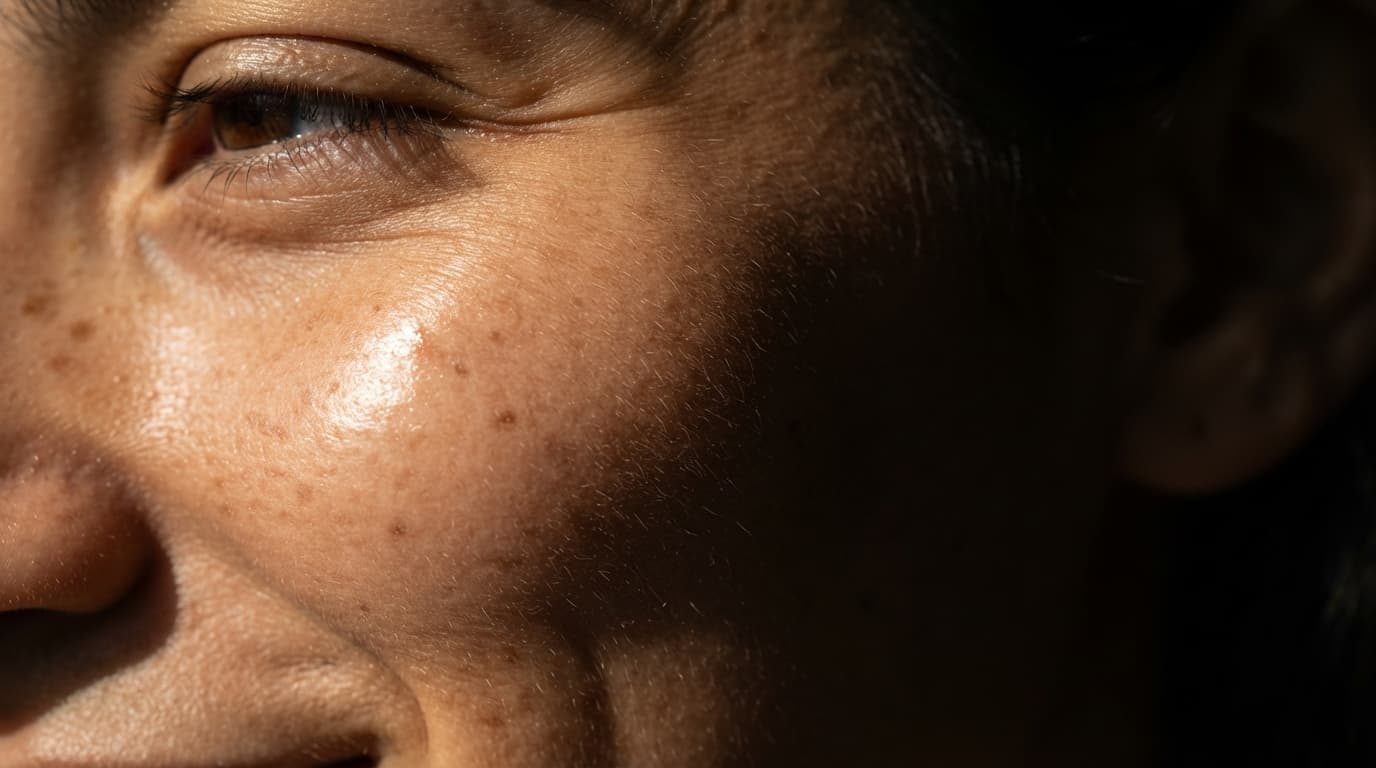
One caution on eyes: "wet eyes" and "glossy tear film" are quality words in a technical costume, naming a highlight rather than a cause. Give the eye something to do and let the specular follow from the light you already specified.
Hands: give them a job
Hands are the traditional embarrassment of generative video and still the thing most likely to end a take. The DeepMind model card does not single them out, but it names their category: "maintaining complete consistency throughout edits, generating scenes with complex motion, or rendering perfectly accurate text remains a challenge." Fingers are complex motion in a small patch of frame, articulated many ways and constantly self-occluding.
The fix is counterintuitive. Do not describe the hands — assign them a task. A hand holding a specific object with a stated grip has a shape and a contact point to anchor to. "Beautiful, elegant hands" supplies neither, and leaves the finger count for the model to invent.
Compare:
- Weak: her hands rest naturally at her sides
- Better: she holds a chipped enamel mug in both hands, thumbs overlapping on the near side
- Weak: he gestures while speaking
- Better: he turns a pen over in his right hand twice, then sets it down on the papers
The second form in each pair fixes the finger count implicitly, gives the motion a start and an end, and produces a beat you can cut on.
One caveat that governs every third-party figure in this post. The two published hands-on reviews we could find — invideo's and the JXP Team's multi-turn test, bylined 21 May 2026 — both name the tested model as Gemini Omni Flash, with no 1.1 suffix anywhere in either piece. Neither measures the model this post is about; read them as evidence about the family. JXP reports that at the fifth editing turn of a violin shot, "Her left hand drifted slightly off the fingerboard." Hands went first, while everything else still held.
Two more rules that cost nothing. Keep hands in one plane of focus — a hand thrust at a wide lens is the hardest thing you can ask for. And keep hands away from the face, because occlusion between two difficult structures compounds the failure rather than averaging it.

You are directing a voice whether you meant to or not
Audio here is native: produced in the same pass as the picture, disabled by no parameter, billed separately by no provider we have checked. A prompt saying nothing about sound is therefore not a request for silence — it is an unsupervised brief, and the model will fill it.
So write the audio deliberately, in its own sentences. Google's documented dialogue form is a colon with no quotation marks — the man says: We lost it — and the much-repeated claim that quotation marks trigger a lip-sync mode appears in no Google document.
Four things decide whether a talking shot works:
Line length. invideo, in a review naming the tested model as Gemini Omni Flash, reports that "For a single person talking, the lip sync holds up until about 6 to 7 seconds before it begins to drop off." A direction rather than a specification, but it points one way: a four-to-twelve word line placed early, then silence and a reaction, beats a sentence running the length of the take.
One speaker in frame. The same review is blunt: "Two speakers in one frame remain a weak spot, since Omni often drops sync or misattributes dialogue, so single-speaker shots are the safe bet today." Make the second person a shoulder at the edge of frame, out of focus, and shoot their line as a separate generation.
Voice direction in prose. No voice parameter exists, so accent, age, register and pacing go in as ordinary English: tired, quiet, American accent, no rise at the end.
Explicit silence. Say No dialogue. or No music.
Before and after for a dialogue shot. The weak version commits every failure above at once — two speakers in frame, quotation marks, a line each, adjectives standing in for direction:
A man in an office says "We lost the contract" to his colleague and she
replies "I know" while they talk to each other, both very emotional,
dramatic scene, cinematic dialogue, photorealistic, perfect lip sync,
realistic voices, high quality conversation, intense acting, beautiful
faces, professional film look, 4k, detailed, award winning drama scene.
The rewrite drops one speaker out of frame, cuts the line to four words, and describes the voice instead of praising it:
In a single continuous shot, no scene cuts. Medium close-up of a man in
his early fifties in a glass-walled meeting room after hours, tie
loosened, two days of stubble, a coffee ring on the papers in front of
him. He is alone in frame; a second person's shoulder sits out of focus
at the right edge. He turns a pen over in his right hand twice, sets it
down, and looks up. The man says: We lost it. Tired, quiet, American
accent, no rise at the end. He holds the look for a beat, then glances
down. Overhead fluorescents plus city light through the glass, 50mm,
shallow depth of field. Sound design: air conditioning hum and one
distant door closing. No music.
Her reply belongs in a second generation, framed on her — two clips instead of one, and still cheaper than re-rolling a two-hander eight times hoping sync lands on both faces at once.
One documented boundary: you cannot take an uploaded video of someone talking and extend it with new dialogue. This is withheld, not missing, and the model card says so plainly — "As part of editing videos, Gemini Omni Flash is capable of changing people's speech. For now, we are restricting this capability and working to better understand how to safely and responsibly bring it to our users." The model can re-voice a person; Google has decided you may not. Dubbing is not a product you can build here.
Crowds, background figures, and where not to spend
Background people get whatever attention is left over, and a busy street of pedestrians is a row of faces that will not survive a pause button. Give a number — "four people at scattered tables" beats "a crowded café", because vague quantity invites approximations. Keep them out of the focal plane, since figures softened by a shallow 50mm are believable where the same figures sharp at f/11 are a gallery of near-misses. And give them one action each, facing away: backs of heads are free. If a specific background face matters, promote it to its own shot.
What the takes cost, and why 4K is the number that matters
Faces are where you burn generations — you re-roll for the eyeline, then the hand, then because the voice came out twenty years too young. Pricing this work honestly means pricing takes, not clips. And the provider gap is widest at the top of the ladder. Ten seconds of 4K, as of 29 August 2026:
| Where you call it | 10s at 4K |
|---|---|
| E2X | $1.80 |
| fal | $3.00 |
| Google, direct | $3.04 |
| Runware | $3.20 |
| WaveSpeed | $3.90 |
Google's figure derives from its published token-per-second rate rather than a sticker price, and fal's is a passthrough of Google's list rather than an independent read on the compute. The spread is structural: from the 720p base, Google charges triple for 4K where we charge double. 41% less at 4K is the widest of our four tiers, and an eight-second take is $1.44 here against $2.43 direct. The provider-by-provider audit has the rest.
The other half of the arithmetic is where you iterate. Ten search passes at 360p plus one 1080p finish comes to $1.73 against $5.40 for ten straight 1080p passes — sixty-eight percent off for one extra generation. A draft pass carries enough resolution for eyeline, blocking and whether the hand found the mug; not enough for skin texture or lip sync, so budget two full-resolution takes after the loop closes. And ask whether the shot needs this model: Veo 3.1 Fast runs a cent a second here, and for a single portrait with no continuation the ninefold premium buys very little.
The limits, stated plainly
Not a disclaimer section. Every item below has changed somebody's project plan.
SynthID is in every frame, and there is no switch. Google's wording: "All generated videos include SynthID watermarking, which is invisible to viewers but can be detected programmatically for provenance verification." No provider exposes a toggle, and because the mark is built to survive re-encoding, cropping and colour changes, "we will strip it in post" is not a plan. If a delivery contract forbids watermarked assets, settle it before you render.
Uploaded-video editing is unavailable in the EEA, Switzerland and the UK. Google's line, including the parenthetical that decides how bad this is for you: "Editing or extending uploaded videos is not currently available for users in the European Economic Area (EEA), Switzerland, and the United Kingdom (editing or extending videos generated by the model is supported)." A European team can still generate a shot and extend its own output; what it cannot do is continue footage a user uploaded. We covered the consequences in the forty-second scenes post — the most expensive item here to discover late.
Uploads containing certain people are refused. Two more lines from the same limitations section, both scoped to those regions: "Uploading and editing images containing minors is not supported in European Economic Area, Switzerland, and the United Kingdom", and "Uploading and editing images containing certain recognizable people is not supported in European Economic Area, Switzerland, and the United Kingdom." The refusal surface looks wider than that wording: JXP, in the same predecessor-era review, reports a prompt naming a real brand "was blocked at submission with a generic policy message", and a request to "age a generic adult character ten years" blocked too. Do not build a pipeline that depends on refusals not happening.
Real people are a legal question before a technical one. A recognisable likeness of an actual person, made without their agreement, runs into personality and publicity rights that vary by jurisdiction and are not waived because the output is synthetic. Separately, transparency obligations under Article 50 of the EU AI Act apply from 2 August 2026: deployers must disclose that content is artificially generated or manipulated, clearly and at first exposure. SynthID answers a machine-readable marking requirement; it does not answer a duty to tell the person watching. That is a labelling decision to make with counsel, not a flag in an API call.
A generated face is not a person, but it can sit close enough to one that somebody is harmed. Consent, disclosure and a willingness to not make the shot belong to this craft the way focal length does.
Common questions
How do you get realistic skin in Gemini Omni 1.1 Flash?
Describe the surface instead of praising it. "Perfect skin", "flawless" and "beautiful" select for retouched commercial imagery and flatten texture. Swap them for observable facts — visible pores across the nose and cheeks, shine on the forehead, a small scar — and state an age. Google asks for extremely detailed character description, which is not the same as asking for an attractive character.
Why do hands look wrong in AI video, and how do you fix it in a prompt?
Fingers are complex motion in a small, self-occluding region, and Google's model card names complex motion as something that "remains a challenge." Give hands a job rather than describing them: a specific object with a stated grip, or an action with a start and an end. Keep them in one plane of focus, away from the face.
Can you turn off audio in Gemini Omni 1.1 Flash?
No. Audio is generated natively alongside the picture, no parameter disables it, and it is not billed separately from the per-second rate. You can steer it with a "Sound design:" sentence and explicit "No dialogue." or "No music." clauses, but not decline it. For silent playback, mute the player.
How should dialogue be written in an Omni prompt?
Use Google's documented form: speaker, colon, line, no quotation marks. Voice direction follows in plain prose, since no voice parameter exists — accent, age, register and pacing all arrive as English. Keep lines short, place them early, describe tone rather than asking for "emotional" delivery.
How long can Gemini Omni hold lip sync?
invideo, in a review naming the tested model as Gemini Omni Flash rather than 1.1, reports that with a single person talking lip sync holds for about six to seven seconds before dropping off, and calls two speakers in one frame a weak spot where the model drops sync or misattributes dialogue. A reviewer's finding on an earlier model, not a Google specification, but it argues for one speaker per generation and short lines placed early.
Can Gemini Omni 1.1 Flash generate a real person's likeness?
Not reliably, and think hard before trying. Google's documentation says uploading and editing images containing certain recognizable people is unsupported in the EEA, Switzerland and the UK, and testers report refusals for real brand names and ordinary character edits. Beyond the filter, likeness rights vary by jurisdiction and are not waived because the footage is synthetic.
Does the SynthID watermark appear on every frame, and can it be removed?
Every generated video carries SynthID, embedded at generation time, invisible to viewers and detectable programmatically. No provider exposes a switch, and the mark survives compression, cropping and colour changes, so removal is not a workflow you can plan around. If a delivery spec prohibits watermarked material, settle that before rendering.
Is it cheaper to iterate on faces at low resolution?
Yes, substantially. Ten search passes at 360p plus one 1080p finish costs $1.73 on E2X against $5.40 for ten passes at 1080p — sixty-eight percent off for one extra generation. Draft passes carry enough resolution for eyeline and blocking, but not for skin texture or lip sync, so plan two full-resolution takes after the draft loop closes.
Prices and product terms change. Check each provider's current pricing before making a purchasing decision.
Schemas and live rates for all four capabilities sit on the model page. Next door: the documented prompt syntax, what forty-second sequences actually cost, and where the same weights sell for more.