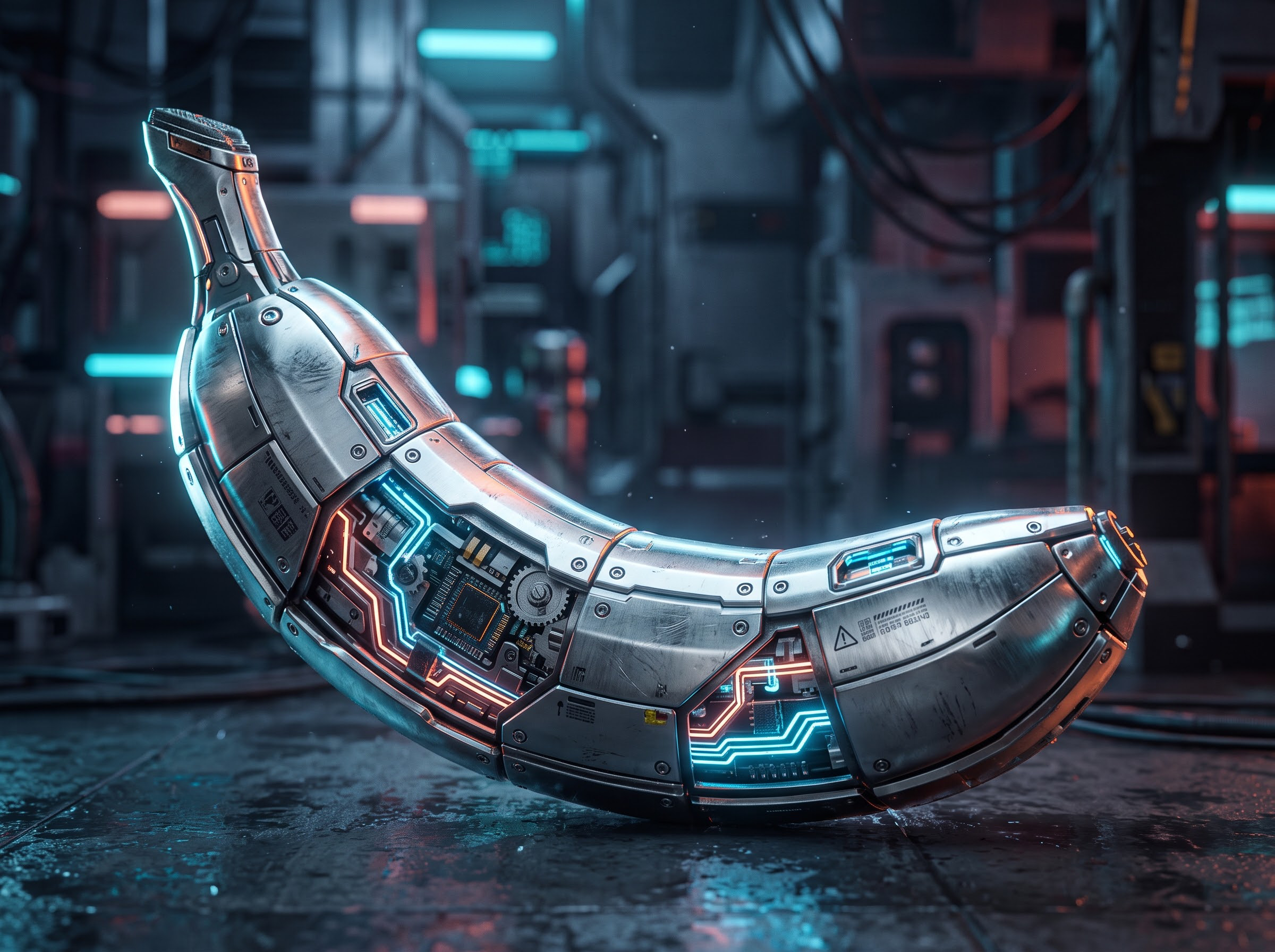
 Image
Image googleNew
Nano Banana 2.1
Google Nano Banana 2.1 at the lowest price globally: $0.03 (1K), $0.04 (2K), $0.09 (4K) with 50% discount. 15 aspect ratios and high prompt fidelity.
- image
- nano-banana-2.1
$0.06$0.03-50%/ req
Lightweight, lower-cost Nano Banana 2 variant for text-to-image and reference-based editing, with extended aspect ratio support.
Sign in to run models
No output yet
Run the model to see generated results.
import requests

result = requests.post(
    'https://api.e2x.ai/v1/jobs/submit',
    headers={
        'Authorization': f'Bearer {API_KEY}',
        'Content-Type': 'application/json'
    },
    json={
  'model': 'google/nano-banana-2-lite/text-to-image',
  'input': {}
}
)import time
job_id = result.json()['jobId']
while True:
response = requests.get(
f'https://api.e2x.ai/v1/jobs/{'{job_id}'}',
headers={'Authorization': f'Bearer {'{API_KEY}'}'}
)
data = response.json()['data']
if data['status'] == 'completed':
print('Done!', data['outputs'][0]['url'])
break
elif data['status'] == 'failed':
raise Exception(f"Job failed: {'{'}data['error']['message']{'}'}")
time.sleep(2)Discover more AI models for Text to Image
Nano Banana 2 Lite is Google's gemini-3.1-flash-lite-image, the speed tier of the Nano Banana 2 generation. We expose it as google/nano-banana-2-lite/text-to-image and we charge $0.0238 per image — around 43% under fal.ai's price for the same model. It generates at 1K resolution only, and it gets there in roughly four seconds.
If you are still calling the original Nano Banana (gemini-2.5-flash-image), read the next two paragraphs before anything else. Google retires that model on 2 October 2026, and its own guidance is blunt: "We recommend upgrading to Nano Banana 2 Lite for better quality, faster speeds and lower costs."
On our platform that upgrade costs you nothing — it refunds you. Legacy Nano Banana runs $0.0312 per image here. Lite runs $0.0238. Newer model, better text rendering, faster generation, and roughly a quarter off the bill. There is no version of that trade where staying put wins. Already have an image you want changed rather than replaced? Nano Banana 2 Lite edit-image takes up to fourteen references at the same price.
Here is where our price sat when we last checked it on August 26, 2026:
| API provider | Price per image (1K) | vs. E2X |
|---|---|---|
| E2X | $0.0238 | — |
| fal.ai | $0.042 | we're 43% lower |
| WaveSpeed | $0.04 | we're 40% lower |
| Google Gemini API | $0.0336 | we're 29% lower |
Prices and product terms can change. Check each provider's current pricing before making a purchasing decision. Google Batch or Flex pricing is not directly equivalent to a standard on-demand API request because scheduling, availability, and processing conditions differ; it is therefore excluded from this comparison. This is a scoped comparison, not a claim that E2X is the world's cheapest option in every configuration.
The honest framing: this is Nano Banana 2 with the resolution ceiling lowered and the thinking budget trimmed. Some things survive that cut intact. Others do not.
Speed is the headline. Google says it "can generate an image in as little as four seconds" — about 2.7× faster than full Nano Banana 2. Filling a thumbnail grid, generating variants behind a loading state, running a batch where wall-clock time is the cost? That ratio matters more than any quality delta.
In-image text holds up. This surprised us. In head-to-head testing Lite ties with Nano Banana 2 on legible, styled text inside the frame — a capability the Gemini 3 generation gained and the legacy model never had. Product labels, poster headlines, UI mockups: Lite renders them.
1K resolution only. No 2K. No 4K. Google's documentation says the model "only supports 1K resolution", and that is not a setting we can raise on our side. If your output goes to print, to a hero banner, or into an upscaling pipeline that needs real detail to work from, this is the wrong model — take Nano Banana 2, which does 0.5K, 1K, 2K and 4K.
No search grounding. Neither Google Search nor Image Search is wired into Lite. Ask it for a real building, a specific product, or a current event and it answers from weights alone. Nano Banana 2 can look things up. This one cannot.
Multi-object prompts are where the gap opens. One subject plus some text? You will not see a difference. Six objects with spatial relationships between them — "the mug behind the notebook, left of the lamp, all on the windowsill" — and Nano Banana 2's deeper reasoning pass wins clearly.
Create a key in your dashboard, keep it on your server, and post to our submit endpoint. Only prompt is required.
curl -X POST https://api.e2x.ai/v1/jobs/submit \
  -H "Authorization: Bearer YOUR_API_KEY" \
  -H "Content-Type: application/json" \
  -d '{
    "model": "google/nano-banana-2-lite/text-to-image",
    "input": {
      "prompt": "A ceramic pour-over dripper on a pale oak counter, morning side-light, shallow depth of field.",
      "aspect_ratio": "4:5"
    }
  }'
You get a job ID back. Poll it, or hand us a webhook:
const headers = {
  Authorization: `Bearer ${process.env.E2X_API_KEY}`,
  "Content-Type": "application/json",
};

const submitted = await fetch("https://api.e2x.ai/v1/jobs/submit", {
  method: "POST",
  headers,
  body: JSON.stringify({
    model: "google/nano-banana-2-lite/text-to-image",
    input: {
      prompt: "Retro travel poster for Trabzon, bold sans-serif title reading 'TRABZON', muted teal and sand palette.",
      aspect_ratio: "2:3",
    },
  }),
}).then((r) => r.json());

const jobId = submitted.data.jobId;

while (true) {
  const job = await fetch(`https://api.e2x.ai/v1/jobs/${jobId}`, { headers })
    .then((r) => r.json());

  if (job.data.status === "completed") {
    console.log(job.data.outputs[0].url);
    break;
  }
  if (job.data.status === "failed") {
    throw new Error(job.data.error?.message || "Generation failed");
  }
  await new Promise((r) => setTimeout(r, 1500));
}
Two schema notes. Our aspect_ratio default here is 1:1 — set it explicitly if you want anything else, and the enum is wide: everything from 21:9 down to the ultra-thin 1:8 and 8:1 strips, plus auto. And there is no resolution field, because there is nothing to choose. The current schema and price always live in the machine-readable spec.
| Model | Price / image | Pick it when |
|---|---|---|
| Nano Banana 2 Lite | $0.0238 | High volume, 1K is enough, latency matters |
| Nano Banana 2 | $0.04 | You need 2K/4K, search grounding, or busy multi-object scenes |
| Nano Banana Pro | $0.075 | Commercial work with typography, role-split references, 4K |
| Nano Banana (legacy) | $0.0312 | Nothing. It shuts down 2 October 2026 — migrate |
| GPT Image 2 | $0.0525 | You want OpenAI's rendering style instead |
Our recommendation is boring, and it matches Google's. Start on Lite. It is the cheapest current-generation image model we run, and for social crops, thumbnails, placeholder art and in-app generation, nothing above it earns its markup. Move up to Nano Banana 2 the first time a client asks for a file bigger than 1024 pixels — or the first time a prompt with five nouns in it comes back with four. You will know when you cross that line.
We keep the legacy row listed because people have running integrations, not because it is a choice. Browse the rest in the text-to-image category or the full model catalog.
Lite still runs a reasoning pass before it draws, just a shorter one. Practical consequence: it rewards prompts that front-load the important thing instead of burying it.
Lead with the subject and the shot. Lighting and material next. Ornamental adjectives last — a shallow thinker spends its budget on whatever it read first. Want text in the frame? Quote it exactly and place it: bold title reading "OPEN LATE" across the top third. If a prompt keeps returning a jumbled composition, split it instead of rewriting it — two Lite calls still cost less than one Nano Banana 2 call.
Every output carries Google's SynthID watermark. It is imperceptible, it is applied to every image without exception, and no provider — us included — has a switch to turn it off. If a client contract forbids watermarked assets, resolve that first.
Budget for 1024-pixel assets everywhere downstream. Teams porting a config from Nano Banana 2 leave a resolution: "2k" in the body and only notice weeks later that a retina layout is running on upscaled 1K. There is no error to catch. Check your dimensions once, at integration time.
It is the product name for Google's gemini-3.1-flash-lite-image, the fastest and cheapest model in the Nano Banana 2 generation. Google positions it for high-volume and near-real-time image workloads, and it is their official recommended replacement for the original Nano Banana.
We charge $0.0238 per generated image, with no resolution multipliers to worry about. That was our price at the August 26, 2026 check, against $0.042 for the same model on fal.ai. Confirm the live model page before you budget against it.
No. Google's documentation states it only supports 1K resolution, and that is a model limit rather than a plan restriction. For 2K or 4K output, use Nano Banana 2 or Nano Banana Pro instead.
Google says it can generate an image in as little as four seconds, roughly 2.7× faster than Nano Banana 2. Editing runs slightly slower than pure generation. Our job pipeline adds queueing on top, so measure end-to-end rather than trusting a single number.
Yes, and soon — Google shuts gemini-2.5-flash-image down on 2 October 2026. On E2X the replacement is cheaper ($0.0238 versus $0.0312), renders in-image text properly, and generates faster. The slug is the only thing that changes in your request body.
No. Neither Google Search nor Image Search grounding is available on Lite. If your prompts depend on current real-world facts or reference lookup, Nano Banana 2 supports grounding and Lite does not.
Yes. Every image includes a SynthID watermark, Google's imperceptible provenance marker for AI-generated content. There is no parameter on any provider that removes it.


